
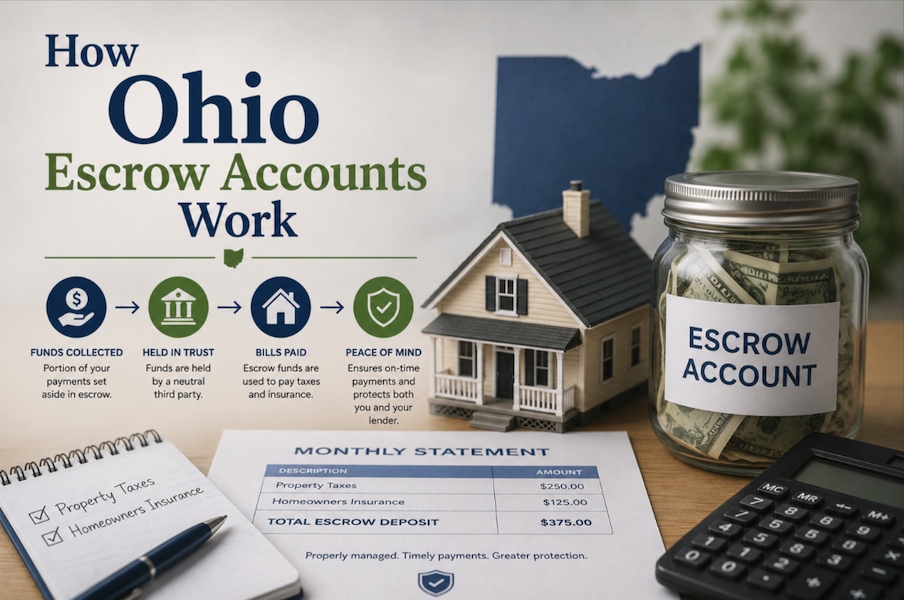
How Ohio Escrow Accounts Work
How Ohio Escrow Accounts Work
Buying or selling a home in Ohio involves a lot of moving parts — inspections, financing, negotiations, and paperwork. One piece that holds everything together is the escrow account. Whether you're a first-time buyer in Columbus, a real estate agent closing deals in Cleveland, or a loan officer working across the state, understanding how escrow works can make every transaction smoother and less stressful.
This article breaks down what an escrow account is, who manages it, what money goes in, and how funds get released at closing — all in plain language.
What Is an Escrow Account?
An escrow account is a neutral holding account managed by a third party — typically a title agency — that holds funds and documents during a real estate transaction. Think of it as a secure middle ground between the buyer and seller.
Neither party has direct access to the funds while the transaction is in progress. This protects everyone involved. The buyer knows their money is safe if a deal falls through for a legitimate reason. The seller knows the buyer has committed real funds to the purchase.
In Ohio, escrow accounts are commonly managed by title agencies like American Homeland Title Agency, which acts as the neutral third party responsible for safeguarding the transaction.
How Escrow Works in an Ohio Real Estate Transaction
Step 1: Opening the Escrow Account
Once a buyer and seller sign a purchase agreement, the escrow process begins. The earnest money deposit — typically 1% to 3% of the purchase price — is submitted by the buyer and deposited into the escrow account. This signals the buyer's serious intent to purchase the property.
Step 2: What Gets Held in Escrow
During the transaction, the escrow account may hold several types of funds and documents, including:
- Earnest money deposits from the buyer
- Down payment funds submitted before closing
- Closing cost contributions from either party
- Seller proceeds temporarily, until all conditions are met
- Loan payoff funds if the seller has an existing mortgage
In some cases, escrow also holds title-related documents, deeds, and other paperwork until all conditions are satisfied.
Step 3: Meeting Conditions Before Disbursement
The funds don't move until all agreed-upon conditions are met. These typically include a clear title search, a satisfactory home inspection, final loan approval from the lender, and the signing of all closing documents. The title agency coordinates with all parties to confirm each condition is satisfied.
Here's a practical example: A buyer in Cincinnati puts $5,000 in earnest money into escrow after signing a purchase agreement. The home inspection comes back with issues, the buyer negotiates repairs, and the seller agrees. Once the repairs are verified and the lender issues a clear-to-close, all parties move forward. That $5,000 gets applied toward the buyer's closing costs at settlement.
The Roles of Each Party in Ohio Escrow
Each participant in an Ohio real estate transaction has a specific role when it comes to escrow.
- The title agency manages the escrow account, performs the title search, coordinates document signing, and disburses funds at closing.
- The buyer deposits earnest money and final funds, reviews closing disclosures, and signs the deed and loan documents.
- The seller confirms payoff amounts for any existing mortgage, signs the deed transfer, and receives their net proceeds after all obligations are cleared.
- The lender provides final loan approval, wires loan funds into escrow before or at closing, and confirms all borrower conditions are met.
- Real estate agents help coordinate timelines, communicate between parties, and ensure contractual deadlines are met so closing stays on track.
When everyone understands their role, closings run efficiently and on time.
How Long Does Escrow Last in Ohio?
In Ohio, a typical residential real estate transaction takes 30 to 45 days from signed purchase agreement to closing. This window allows time for the title search, mortgage underwriting, inspections, and any required repairs or negotiations.
Cash transactions can close faster — sometimes in as few as 10 to 14 days — because there's no lender underwriting process to wait on.
Once the closing date arrives, the title agency disburses all funds: the seller receives their proceeds, the lender receives any payoff amounts, and the buyer receives the keys and title to the property.
Why Escrow Matters for Ohio Buyers, Sellers, and Professionals
Escrow isn't just a formality — it's a protection mechanism for everyone in the deal.
- For buyers, it ensures your funds are only released when the transaction is complete and all conditions are satisfied.
- For sellers, it confirms the buyer's financial commitment before you take the property off the market.
- For real estate agents and loan officers, it creates a structured timeline that keeps transactions organized and on schedule.
- For business owners involved in commercial real estate, escrow provides the same layer of security at a larger financial scale.
Work With a Trusted Ohio Title Agency
Escrow accounts are a straightforward concept with a powerful purpose: they keep money safe and transactions honest. When a professional title agency manages the process, buyers and sellers can move forward with confidence knowing every dollar is accounted for.
At American Homeland Title Agency, our team handles Ohio escrow accounts with precision, transparency, and a commitment to smooth closings. If you have questions about an upcoming transaction or want to learn how we can support your next deal, reach out to our team today.