
Construction Activity and Housing Supply: What It Means for Buyers
Construction Activity and Housing Supply
What It Means for Buyers
A Mixed Signal: Permits Up, Starts Down
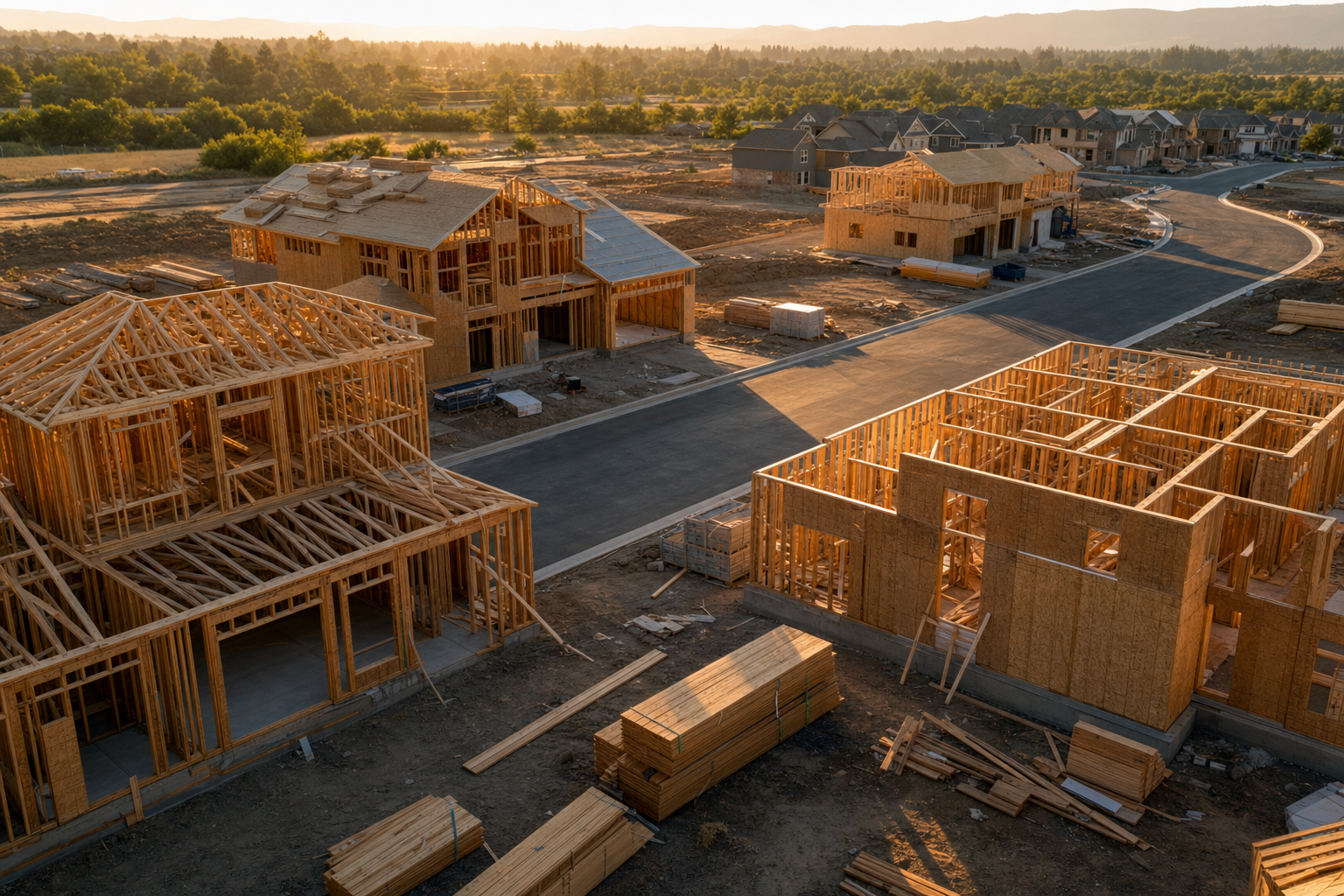
The U.S. Census Bureau and HUD's July 2026 New Residential Construction report showed a notable divergence that's worth understanding if you're tracking future housing supply. Building permits, a forward-looking indicator of construction that hasn't broken ground yet, rose 5.0% month-over-month to a seasonally adjusted annual rate of 1,443,000 units, up 3.1% from a year earlier — a genuinely encouraging signal on its face. Housing starts, however, told a very different story, falling 12.4% from June to a seasonally adjusted annual rate of just 1,239,000 units, down a steep 13.5% from July 2025. In other words, builders are lining up more approvals for future projects even as they actively pull back on breaking ground right now, a signal of real caution about current demand conditions even while they work to preserve their development pipeline for whenever conditions improve.
Single-Family Construction Is Under the Most Pressure
Single-family housing starts — the type of construction most directly relevant to typical individual homebuyers rather than large multifamily developers — fell 9.9% month-over-month in July to an annualized rate of 808,000 units, a steep 15.7% decline from a year earlier, according to Census Bureau data reported by HousingWire. Single-family permits, by contrast, rose a more modest 2.5% month-over-month and were up just 1.1% year-over-year, a far smaller gain than the permit increase seen in the multifamily segment. This growing gap between permits and actual starts in the single-family segment suggests builders are holding back on breaking ground on new homes even where they've already secured the necessary approval to build, likely reflecting elevated construction financing costs and softer buyer demand at many price points across the market.
Regional Variation Across the Country
Construction activity hasn't moved uniformly across different parts of the country, and buyers should be cautious about applying national headlines directly to their own local market. TD Economics' analysis of the July data found housing starts fell sharply in the Midwest (down 27.6%), the West (down 13.8%), and the South (down 12.6%), while the Northeast was the only region posting an actual gain, up 17.1% and recording its second consecutive monthly increase in a row. On the permit side, the South continued to lead in raw volume of units, though permits there actually declined 4.7% month-over-month — a notable reversal for a region that had led much of the post-pandemic construction boom in prior years. Buyers should recognize that national construction headlines don't necessarily reflect what's actually happening in their specific metro area or county.
What Slower Construction Means for Housing Supply
When housing starts fall while population growth and new household formation continue at a steady pace, the net effect over time tends to be a tighter overall housing supply, which in turn tends to support existing home prices even in a higher mortgage rate environment that would otherwise be expected to cool demand. Housing completions also fell 9.1% month-over-month in July to an annualized rate of 1,212,000 units, down a substantial 16.8% from a year earlier, meaning fewer brand-new homes are actually reaching the market to relieve pressure on existing-home inventory. For buyers who had been hoping new construction would meaningfully expand their available options and ease competition for existing homes, this data suggests that relief may be slower to materialize than many had hoped, at least in the near term ahead.
What This Means for Ohio Buyers Specifically
Locally, permit activity in Southwest Ohio has been genuinely mixed rather than booming in either direction. Cincinnati's new housing permits were reported running roughly 14% below the prior year's pace through much of the year, even as overall building permit activity in the city — including renovations, additions, and smaller residential projects — stayed roughly flat compared to the same period a year earlier. For buyers, this suggests new construction inventory in the region likely won't expand dramatically in the near term, keeping competition for well-priced existing homes very real for the foreseeable future. If you're considering new construction specifically, expect builders in the current climate to be more open than usual to negotiating incentives like mortgage rate buydowns or design-upgrade credits, given that many are cautious about starting speculative homes without a confirmed buyer already lined up.
Provided by American Homeland Title Agency
For advertising purposes only.
Equal Housing Opportunity — we support fair and equal access to housing for all, regardless of race, color, religion, sex, handicap, familial status, or national origin.